

TL;DR Palliative care is for anyone with a serious illness at any stage and works alongside active treatment. Hospice is a specific, intensive form of palliative care for when comfort becomes the primary focus over curative treatment. All hospice is palliative care, but not all palliative care is hospice. Both are covered by Medicare, Medicaid, and most private insurers, and both support the patient and the family through interdisciplinary teams.
When a loved one receives a serious illness diagnosis, families are often confronted with a wave of medical terminology that can be confusing and overwhelming. Two terms that come up frequently are hospice care and palliative care. Many people use them interchangeably, but they are not the same thing.
Understanding the real difference between hospice and palliative care can help families make more informed decisions, ask better questions, and access the right level of support at the right time.
What Is Palliative Care?
Palliative care is specialized medical care focused on relieving symptoms, managing pain, and improving quality of life for people living with a serious illness. The key distinction that sets palliative care apart is that it can begin at any stage of illness, including at the time of diagnosis, and can be provided alongside curative or active treatment.
According to the World Health Organization (WHO), palliative care is an approach that improves the quality of life of patients and their families facing problems associated with life-threatening illness, through the prevention and relief of suffering.
Palliative care is delivered by an interdisciplinary team that typically includes:
- Physicians and nurse practitioners
- Registered nurses
- Social workers
- Chaplains and spiritual care providers
- Physical and occupational therapists
- Music therapists and other allied health professionals
The goal is not to replace your regular medical team, but to work alongside them. Palliative care addresses the physical, emotional, social, and spiritual dimensions of a patient’s experience, offering an additional layer of support that standard medical care may not always provide.
Conditions commonly treated with palliative care include:
- Cancer (at any stage)
- Congestive heart failure (CHF)
- Chronic obstructive pulmonary disease (COPD)
- Kidney failure and renal disease
- Parkinson’s disease
- Multiple sclerosis
- Dementia and Alzheimer’s disease
- ALS (amyotrophic lateral sclerosis)
- Pulmonary fibrosis
To learn more about what a palliative care plan involves, read: Five Stages of Palliative Care: What Families Should Know
Wondering if palliative care is right for your loved one? Explore what specialized palliative support looks like and how it can be delivered at home. Learn About Palliative Care Services
What Is Hospice Care?
Hospice care is a specific, highly specialized form of palliative care. It is designed for individuals whose illness has progressed to a point where the focus of care shifts from curative or disease-modifying treatment toward comprehensive comfort-focused support.
Hospice care prioritizes dignity, comfort, and quality of life. It supports not just the patient, but the entire family unit, offering a wide range of services that address physical symptoms as well as emotional and spiritual wellbeing.
According to the National Hospice and Palliative Care Organization (NHPCO), hospice is a philosophy of care rather than a place. Hospice services can be provided at home, in a nursing facility, in an assisted living community, or in a dedicated inpatient hospice setting.
Hospice care typically includes:
- Skilled nursing visits for symptom and pain management
- Physician oversight and care coordination
- Aide and homemaker services
- Social work and counseling
- Chaplaincy and spiritual support
- Medical equipment and supplies
- Medications related to the primary diagnosis
- Bereavement support for family members
- Therapies such as music therapy and physical therapy
To understand what goes into building a hospice care team, read: The Hospice Care Team
Hospice vs. Palliative Care: The Core Differences
Despite being related, hospice and palliative care differ in some fundamental ways. Here is a clear side-by-side comparison:
| Feature | Palliative Care | Hospice Care |
| When it begins | Any stage of illness | When curative treatment is no longer being pursued |
| Treatment alongside | Yes, including curative treatment | Focused on comfort; curative treatment is not the goal |
| Who qualifies | Anyone with a serious illness | Individuals with a serious, life-limiting illness |
| Setting | Hospital, clinic, or home | Home, nursing facility, inpatient setting |
| Duration | As long as needed, even indefinitely | Ongoing, with regular reassessment |
| Insurance coverage | Medicare, Medicaid, most private insurers | Medicare Hospice Benefit, Medicaid, most private insurers |
| Care team | Interdisciplinary team | Interdisciplinary team with expanded support services |
The simplest way to understand the relationship: all hospice care is a form of palliative care, but not all palliative care is hospice.
When Should Palliative Care Begin?
One of the most common misconceptions about palliative care is that it is only appropriate when someone is seriously ill with limited time remaining. In reality, research consistently supports earlier involvement of palliative care.
A landmark study published in the New England Journal of Medicine found that patients with advanced lung cancer who received early palliative care alongside standard treatment reported better quality of life, fewer depressive symptoms, and in some cases lived longer than those who received standard care alone.
Palliative care is appropriate from the moment a serious diagnosis is made. Starting early gives patients and families more time to:
- Understand their diagnosis and treatment options
- Manage symptoms before they become severe
- Address emotional and spiritual concerns proactively
- Build a relationship with their care team
- Plan for what they want as their condition evolves
For a deeper look at what early palliative support can accomplish, explore: What Is Palliative Care?
Have questions about when palliative care is appropriate? Connect with a care team that can walk you through your options, at no obligation. Book a Consultation
When Is Hospice Care Considered?

Hospice care becomes the appropriate focus of care when someone with a serious illness, in consultation with their medical team, decides to shift their care goals. This transition is deeply personal and should never be rushed or made without careful consideration and honest communication with healthcare providers.
Hospice is typically recommended when:
- A physician determines that the patient’s illness is following its expected course
- The patient and family have decided that their priority is comfort and quality of life
- Continuing curative treatment is no longer aligned with the patient’s goals
It is important to note that entering hospice is not a decision made in isolation. It is a conversation involving the patient, their family, and their medical team. Hospice enrollment can also be reversed; patients who improve or who wish to return to curative treatment may leave hospice at any time.
If you are trying to understand when hospice may become a consideration, this resource can help: When Is It Time for Hospice?
How Are Hospice and Palliative Care Paid For?
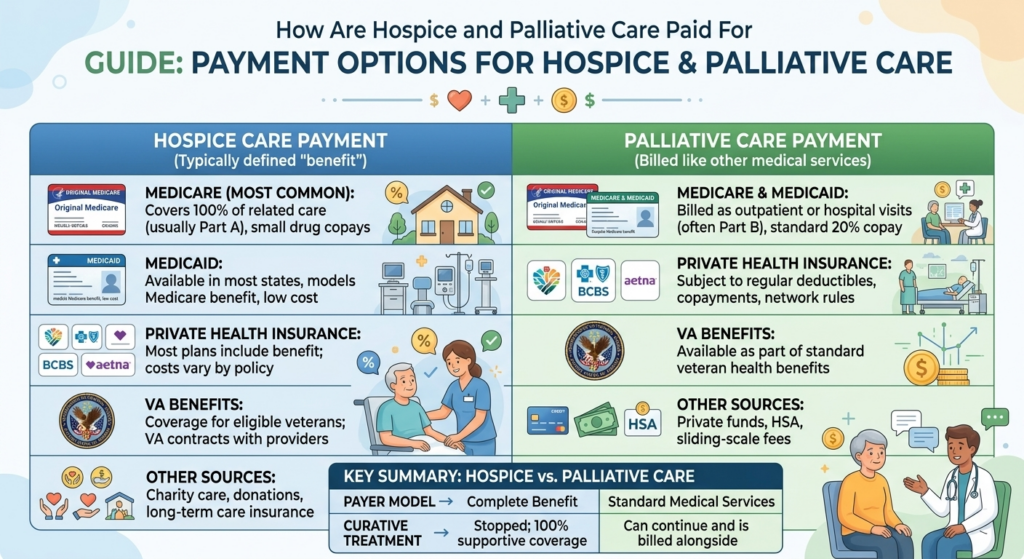
Understanding the financial side of serious illness care is an important part of planning. Both hospice and palliative care are covered by most major insurance programs, though the specifics vary.
Paying for Palliative Care
Palliative care services are covered under Medicare Part B when provided in outpatient or home-based settings. Medicaid coverage varies by state, and most private insurance plans also cover palliative services, particularly when tied to a serious diagnosis.
For a full breakdown, visit: Who Pays for Palliative Care?
Paying for Hospice Care
Hospice is covered under the Medicare Hospice Benefit, which covers virtually all hospice-related services including nursing, medications, therapies, and support services. Medicaid and most private insurers have comparable hospice benefits.
One important nuance: under Medicare, patients electing the hospice benefit agree to receive care focused on comfort rather than pursuing curative treatment for the primary diagnosis. This is a significant decision and one that should be discussed thoroughly with a physician.
For more information: Paying for Hospice Care | FAQs About Paying for Hospice
The Centers for Medicare and Medicaid Services (CMS) also provides detailed guidance on what the Medicare Hospice Benefit covers.
The Role of Emotional and Spiritual Support in Both Settings
A common thread in both palliative and hospice care is the emphasis on whole-person support. Managing physical symptoms is essential, but care teams also address the emotional, psychological, and spiritual dimensions of living with a serious illness.
Families navigating these situations often experience significant stress, grief, and caregiver fatigue. Research from the American Psychological Association highlights that family caregivers are at increased risk for anxiety, depression, and burnout when adequate support is not in place.
Both hospice and palliative care teams include social workers and chaplains who are trained to support patients and families through these challenges. Services such as emotional and spiritual care can be invaluable for families trying to process a difficult diagnosis or the evolving needs of a loved one.
If caregiver wellbeing is something you are thinking about, this article offers helpful guidance: Recognizing the Signs of Caregiver Burnout and How to Prevent It
Can Someone Receive Both Palliative and Hospice Care?
This is a question many families ask, and the answer requires a bit of clarification.
Palliative care and hospice are not delivered simultaneously as two separate programs. Rather, hospice is a specialized, benefit-based program that incorporates palliative principles throughout. When a patient is enrolled in hospice, they are receiving an intensive form of palliative care that is designed for their specific situation.
What some patients do is receive palliative care early in their illness journey and then, at a certain point, transition into hospice as their care goals evolve. This transition can be a smooth and well-supported process when a consistent care team is involved.
Not sure which type of care is right for your family? Explore the full range of hospice and palliative care services available. View All Services
Debunking Common Myths About Hospice and Palliative Care
Myth 1: “Palliative care means giving up on treatment.”
This is one of the most persistent misconceptions. Palliative care is not about giving up; it is about adding support. Patients receiving palliative care can and do continue curative or active treatments. The palliative team works in partnership with the treatment team.
Myth 2: “Hospice is only for the final days of life.”
Hospice care is not a last-resort option reserved for the final hours or days of life. People can receive hospice care for weeks or months. Earlier hospice enrollment often means more time to benefit from the full scope of services available.
Myth 3: “You can only receive hospice care in a hospital.”
Hospice is most commonly provided at home. Hospice care at home allows patients to remain in a familiar environment surrounded by the people they love, with a skilled care team making regular visits and available around the clock.
Myth 4: “Palliative care is only for older adults.”
Palliative care is appropriate for patients of any age living with a serious illness. Children, young adults, and middle-aged individuals with serious diagnoses can all benefit from palliative support.
Myth 5: “Hospice and palliative care are the same thing.”
As this article has outlined, while they share a philosophy, they are distinct programs with different eligibility criteria, service scopes, and goals.
Understanding the Hospice Care Team
One of the defining features of hospice care is the interdisciplinary care team. Unlike a single provider, hospice involves multiple professionals working together toward a shared goal. A standard hospice team typically includes:
- A hospice physician who collaborates with the patient’s primary doctor
- Registered nurses and licensed practical nurses for regular visits and 24-hour support
- Home health aides for personal care
- A medical social worker to address practical and emotional needs
- A chaplain or spiritual care advisor
- Trained volunteers who provide companionship and respite support
- A bereavement coordinator for family support
For a detailed overview of who is involved: The Hospice Care Team
Key Takeaways: Hospice vs. Palliative Care
To summarize the most important points:
- Palliative care can begin at any stage of serious illness and is provided alongside any other treatment. Its goal is to improve quality of life by managing symptoms and supporting the whole person.
- Hospice care is a specialized, benefit-based program focused entirely on comfort and quality of life for individuals whose illness has progressed to a certain point and who have decided to prioritize comfort over curative treatment.
- Both types of care are covered by Medicare, Medicaid, and most private insurance plans.
- Both involve interdisciplinary teams that address physical, emotional, social, and spiritual needs.
- Hospice is a form of palliative care, but palliative care is a broader category that applies across the entire illness journey.
Making sense of serious illness care options is difficult enough without confusion over terminology. Whether your family is exploring palliative care for someone newly diagnosed or beginning to consider hospice, having accurate information is the foundation for good decision-making.
For further reading, the National Institute on Aging provides a clear and authoritative overview of both types of care.
Have questions about hospice or palliative care in your area? Reach out to learn more about what compassionate, comfort-focused care can look like for your family. Contact Us | Call 24/7: 1- 888 635-6347
FAQs
What is the main difference between hospice and palliative care?
The primary difference is timing and the relationship to curative treatment. Palliative care can be provided at any point during a serious illness, including while curative treatment is ongoing. Hospice care is a specific program for individuals who have decided to focus on comfort rather than pursuing curative treatment, typically when a physician has determined that the illness is following its expected course.
Can a patient switch from palliative care to hospice care?
Yes. Many patients receive palliative care during active treatment and later transition to hospice as their goals or medical situation evolves. This transition is common and can be a well-coordinated process when a consistent care team is involved.
Is palliative care only available in hospitals?
No. Palliative care can be provided in many settings, including hospitals, outpatient clinics, and at home. Home-based palliative care has grown significantly and is often the preferred option for patients who wish to remain in a comfortable, familiar environment.
Does receiving palliative care mean treatment will stop?
Not at all. Palliative care is designed to complement active treatment, not replace it. Patients can continue chemotherapy, radiation, dialysis, or other treatments while receiving palliative care support at the same time.
How do I know if my loved one qualifies for hospice care?
Eligibility for the Medicare Hospice Benefit generally requires a physician certification that the illness is following its expected course and that the patient is choosing comfort-focused care. A hospice provider can work with your loved one’s physician to assess eligibility. You can review the general criteria at: About Hospice Care
Are hospice and palliative care covered by Medicare?
Yes. Hospice care is covered under the Medicare Hospice Benefit. Palliative care services are covered under Medicare Part B. Both Medicaid and most private insurers also have coverage provisions for these services. For more detail: Paying for Hospice and Who Pays for Palliative Care
Can hospice care be provided at home?
Yes. Hospice care is most commonly delivered at home, allowing patients to remain in a familiar and comfortable setting. A hospice team makes regular visits and provides around-the-clock phone support. Learn more: Hospice Care at Home
What does a palliative care team do?
A palliative care team addresses the full spectrum of a patient’s needs, including pain and symptom management, emotional and psychological support, spiritual care, help navigating medical decisions, and coordination between providers. The team typically includes physicians, nurses, social workers, and chaplains. Learn more: What Is Palliative Care?
How do I get a referral for palliative or hospice care?
For palliative care, a referral can come from your primary care physician or a specialist. For hospice, a physician referral and certification are typically required. In many cases, you can also contact a hospice or palliative care provider directly to begin the conversation. Book an appointment or call for guidance at any time.
Is there support for family members, not just patients?
Yes. Both palliative and hospice care programs include services for family members and caregivers. This includes counseling, education, respite support, and bereavement care. Supporting the family is considered an essential part of quality hospice and palliative care. Explore: Emotional and Spiritual Care and Bereavement Support
This article is intended for educational purposes only. It is not a substitute for professional medical or legal advice. Eligibility criteria and insurance coverage may vary depending on individual circumstances.