

None of us can predict when a health change might make it hard to speak for ourselves. An advance directive is a simple, practical way to make sure your voice is still heard. It lets you write down the care you want and name a trusted person to speak with your doctors if you can’t.
At Melodia Care, we help families have these conversations every day. This guide explains what an advance directive is, what goes into one, how to complete it in California, and how to keep it working for you over time.

What Is an Advance Directive?
An advance directive is a legal document that records your health care wishes ahead of time. It only comes into use if you become unable to make or communicate your own medical decisions, for example after a serious illness, a stroke, or a period of confusion.
In California, the official version is called the Advance Health Care Directive (AHCD). It is governed by the state’s Health Care Decisions Law in the California Probate Code. The state provides an optional form, but you can use any form that meets the legal requirements.
An advance directive is not just for older adults or people with a serious diagnosis. Any adult aged 18 or older can and should have one.
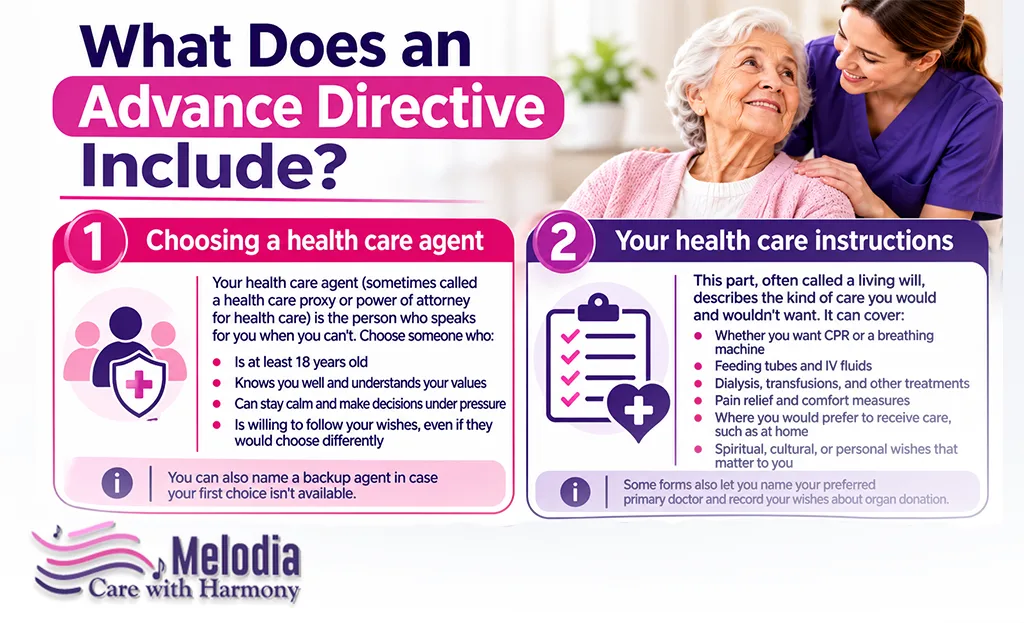
What Does an Advance Directive Include?
Most advance directives have two main parts. You can complete one or both.
1. Choosing a health care agent
Your health care agent (sometimes called a health care proxy or power of attorney for health care) is the person who speaks for you when you can’t. Choose someone who:
- Is at least 18 years old
- Knows you well and understands your values
- Can stay calm and make decisions under pressure
- Is willing to follow your wishes, even if they would choose differently
You can also name a backup agent in case your first choice isn’t available.
2. Your health care instructions
This part, often called a living will, describes the kind of care you would and wouldn’t want. It can cover:
- Whether you want CPR or a breathing machine
- Feeding tubes and IV fluids
- Dialysis, transfusions, and other treatments
- Pain relief and comfort measures
- Where you would prefer to receive care, such as at home
- Spiritual, cultural, or personal wishes that matter to you
Some forms also let you name your preferred primary doctor and record your wishes about organ donation.
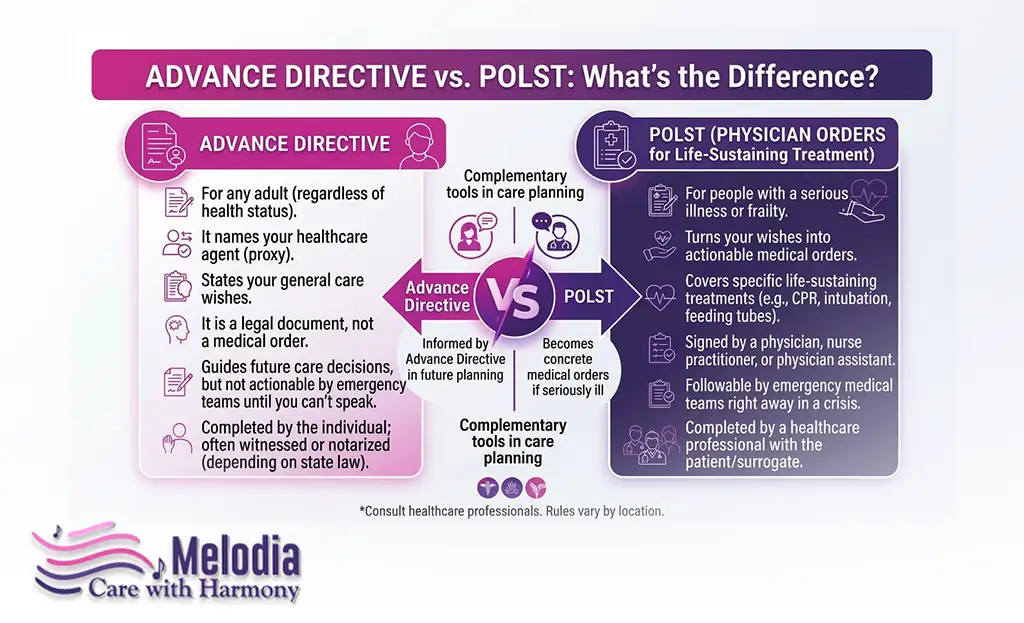
Advance Directive vs. POLST: What’s the Difference?
Families often confuse these two documents. They work together, but they are not the same.
- An advance directive is for any adult. It names your agent and states your general wishes. It is a legal document, not a medical order.
- A POLST form is for people with a serious illness or frailty. It turns your wishes into medical orders signed by a physician, nurse practitioner, or physician assistant, so emergency teams can follow them right away.
Many people living with a serious illness have both. To learn more, read our guide to the POLST form in California.
How to Complete an Advance Directive in California
- Get the form. You can use the state’s statutory form, a version from your health system, or one prepared by an attorney. Many hospitals and doctor’s offices offer free copies.
- Think about what matters to you. Consider your values, your faith, and what a good quality of life means to you.
- Talk with the person you want as your agent. Make sure they agree to the role and understand your wishes.
- Fill out the form. Complete Part 1, Part 2, or both.
- Sign and date it. Then either have it signed by two qualified adult witnesses or acknowledged by a notary public. You only need one of these options. An electronic directive must be notarized.
- Share copies. Give copies to your agent, your doctors, your hospice or home care team, and close family members.
Witness rules to know: Your agent cannot be a witness. Your health care provider and their employees generally cannot be witnesses. Only one witness can be related to you by blood, marriage, or adoption. If you live in a skilled nursing facility, California also requires a patient advocate or ombudsman to sign as a witness.
This article is for general information only and is not legal advice. For questions about your situation, speak with an attorney or your health care provider.
When Should You Create an Advance Directive?
The best time is now, while you are well and able to think clearly. Some moments make it especially important:
- Turning 18, or when a young adult leaves home
- Getting married, divorced, or having children
- Receiving a new diagnosis or starting a new treatment
- Before a planned surgery or hospital stay
- When considering palliative care or hospice care
Keeping Your Advance Directive Up to Date
Your wishes may change over time, and that’s completely normal. Review your directive every few years and whenever your health or family situation changes. You can update or cancel it at any time while you are able to make your own decisions. When you make a new one, collect and destroy old copies so there is no confusion.
Store the original in a safe but easy-to-find place. Avoid locking it in a safe deposit box, because your family may need it quickly.
How to Start the Conversation With Your Family
Talking about future care can feel uncomfortable, but most families say they feel relieved afterward. A few tips:
- Pick a calm, unhurried moment, such as a family meal or a quiet weekend
- Start with values: “What matters most to you if you get very sick?”
- Share your own wishes first to make it easier for others
- Remember it doesn’t have to happen in one conversation
For more ideas, see our list of good questions to ask about your loved one’s care and our hospice planning checklist.
How Melodia Care Can Help
Our hospice social workers and care team help patients and families understand their options, complete advance care planning documents, and make sure every member of the care team knows the patient’s wishes. Learn more about the role of a hospice social worker.
Do I need a lawyer to make an advance directive?
No. In California you can complete an advance directive without a lawyer, as long as it is signed and either witnessed by two qualified adults or notarized.
Is an advance directive the same as a will?
No. A will covers your property and finances. An advance directive covers only your health care decisions.
Is a California advance directive valid in other states?
Many states honor directives made in other states, but rules vary. If you spend a lot of time in another state, consider completing that state’s form too.
Can my agent override my written wishes?
Your agent is expected to follow your instructions and act in your best interest. That’s why it’s so important to choose someone you trust and talk openly with them.
Plan Ahead With Confidence
An advance directive is a gift to yourself and the people you love. It brings clarity, reduces stress during hard moments, and keeps your care centered on what matters to you. If you have questions about advance care planning or hospice services, call Melodia Care at 1-888-MELODI-7. We’re here to help, with care in harmony.